

I found myself thinking about a pinball machine over breakfast one day. The original idea was to build a new pinball table from scratch. And I mean the real thing. Do I have any prior experience or knowledge of how to do this, you ask? Not at all, but so what?
Virtual cabinets
After learning that creating a new game could cost thousands upon thousands (and that was just to get someone to design it for me), I found people online building virtual cabinets. Just throw a TV inside the cabinet and you are away. What I was not sure about was how it would feel. Would it be a big console experience, or would it actually feel like playing a real pinball table?
I found the Pinscape build guide, which turned out to be the bible of building a virtual pinball cab. The other resource was Way of the Wrench's YouTube playlist.
If I may fast-forward in the story: the speakers inside the cabinet that replicate the flipper and ball-rolling sounds are super realistic. It feels like having a real pinball cab in front of you, with the graphics and sounds doing most of the heavy lifting. You can still nudge the table, and you do not have to put your own coins in the machine. All of that adds up to an amazing experience. Then you throw more toys into the cab, like some LED strips, and you are doing very well while still being far, far away from the $15k price tag of a real machine.
Building the cabinet
The first question I asked myself was where to start. I built the arcade from scratch, but the pinball cab meant I did not quite have the tools I needed, so I got a local business to CNC the parts for me. Why? Because I do not enjoy cutting parts out of wood. They will all be wonky. Screwing it together and painting? Easy!
Before I did that, however, I decided a Williams widebody cabinet was going to be best. I wanted a large TV screen in the playfield (the bottom cabinet, where the table would normally be), and I decided I wanted three screens: one for the back artwork (backbox), one to show the score (DMD), and a TV for the playfield. 4K? Don't mind if I do.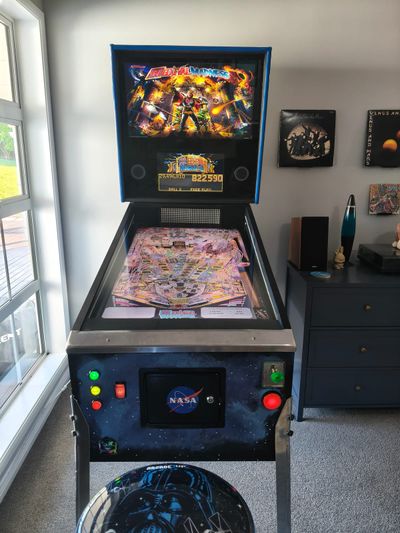
The NASA logo on the coin door is not random pinball decoration either. That sticker came from the crew who fly the C17s down to Antarctica, and once one of those ends up in your hands it has to go somewhere, so the cab got it.
Space and budget
Once I made those decisions, I had a direction. Lesson one: before you think about a pinball cab, think about how much space it is going to take up. You might not be able to do a full widebody. You might only have the space and budget to build a playfield. The other cheap way is to partially build a box to store the electronics and use a VR headset, saving you even more time, money and space.
Those decisions are all yours, but for me, I wanted the full thing.
What comes next
The rest of this story will not be about measurements and exact details. It will be about the issues I ran into, the shortcuts I took, and the places where I decided to use real methods and parts from an actual cabinet.
I never thought a pinball cabinet build would be so personal, but it is. You have to decide how you want to get around a few hurdles if you want to build one. Maybe you love woodworking and have access to a workshop. Perfect! You can save some money there. For me, I had a personal gaming machine with a 3060 graphics card inside. The problem was that I never played games on it, so I used that exact machine as the starting point for this build. The only things I actually used it for were coding and boring chores, and those ran fine on a laptop, so that is what I did.
I also found a real Williams widebody lockdown bar (the metal bit you tend to rest your hands on), so I bought that for $50 NZD. Some people, like the Way of the Wrench YouTube channel, actually fabricate their own, but that is not for me.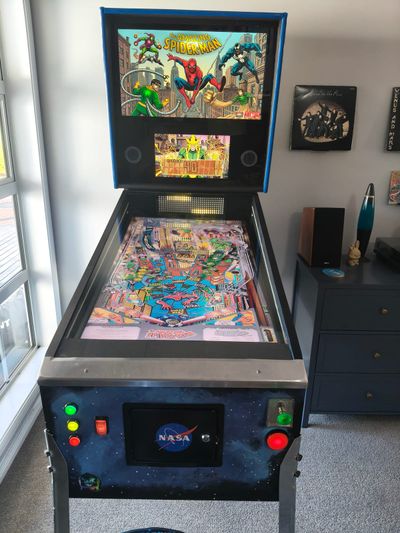
Let's talk computers in the next post!